Arthur Ross

Hall of Fame

Arthur Ross

Born:  1895
Died:  1975
Inducted:  2006

Arthur George Francis Ross was born in Christchurch New Zealand and was the third son of Edward James and Ginny Ross (nee Cox).  His father was the founding Secretary of the United Tennis, Bowls and Croquet Club in Christchurch and was a driving force in the formation of the New Zealand Croquet Council in 1920.

Arthur subsequently attended Christ's College in Christchurch and took up croquet in his teens.  In 1915, he won his major title, the New Zealand Doubles Championship with H.A. Penn, and was also runner-up to Keith Izard in the New Zealand Singles Championship.

He fought in World War 1 where, in the latter stages, he was gassed at Ypres.  His two brothers were both killed in action.

During his many months of convalescence at Hanmer Springs, he refined his game and evolved his distinctive and memorable style before resuming play in the 1920 New Zealand Championships where he again won the Doubles Championship with Penn.

Following recuperation, he became a poultry farmer and later a schoolteacher in North Canterbury, New Zealand, a position which also required him to drive the school bus over hazardous back country roads.  He retired in 1951.

His croquet success continued and he won the New Zealand Singles Championship 11 times, was runner-up a further eight times, won the New Zealand Men Championship six times and the British Open Championship in 1954.

In 1930, he made his debut in the MacRobertson Shield, eventually representing New Zealand no less than six times and captained the first New Zealand team to win the Shield in 1950.

At various times, he held every office on the New Zealand Croquet Council (President 1928-1930, Secretary 1932-1935, Vice-President and Referee 1935-1952) and started the New Zealand Croquet Council Gazette as editor, at his own expense.  He wrote "Croquet and How to Play it" which ran to no less than five editions and, due to his acknowledged international authority on the Laws of the Game, the "Powers and Duties of an Umpire" in 1946.

He was actively involved in coaching around the country, often finding himself battling to hold breaks together while demonstrating on some odd proportioned lawns at out of the way clubs, playing with a pipe in his mouth that he would sometimes throw to the boundary as his break became more involved.

In 1952, he was officially recognised as a leading luminary in the sport with the award of a Life Membership of the New Zealand Croquet Council.

He was married twice, namely to Violet Ross (nee Minchen), who died in 1974, and to Lena Ross (nee Ashworth) who also died in 1974.  He had three sons, Hugh (b.1925, d.1992), Terence (b.1927), Peter (b.1940) and his only daughter Jean (b.1930) was at one time married to Ashley Heenan.

Arthur was a wonderfully kind hearted man.  When asked late in life about his croquet record, he only reluctantly gave the details but said that his grandchildren were his best record.

Sometimes known as “The father of the triple peel”, Arthur Ross died at Motueka, New Zealand in 1975.

In 1979, the Ross family and his son-in-law, Ashley Heenan presented to the New Zealand Croquet Council the Arthur Ross Memorial Trophy for the New Zealand National Handicap Event to encourage croquet at grass roots level, something in which Ross believed passionately.

Nigel Aspinall

Hall of Fame
Nigel Aspinall

Born: 1946
Inducted: 2007

Nigel's rise to the top of the sport was nothing short of spectacular.  Studying as an undergraduate at Bristol University, he arrived as a new member at the local Bristol club in 1965 at the age of 19 or so and was immediately given a handicap of six.  He had, he later explained, played a bit at home from the age of 12 or so.  His father had bought a second-hand croquet set and the family had played on a former grass tennis court - despite two Victoria plum trees.  They made up their own rules.

In Bristol, he discovered the real game.  "I could," he says, "hit one ball on to another, at, say, 10 or 15 yards, and I think I had a basic idea of tactics.  But I was playing roll shots inaccurately, and I think I was still playing the sequence game."

A few weeks after arriving at Bristol his handicap was reduced to 3.  He had time before the end of the season for a weekend tournament at Cheltenham and a visit to Parkstone in September.  Next season, with a handicap of 1, he played in the Open Championship at the suggestion of a fellow club member, John Simon.  Together, they won the Open Doubles Championship.  Both were then selected for the President's Cup and Aspinall came joint second to William Ormerod.

Nigel had gone from his first tournament to selection for the President's Cup in just 10 months!  What is all the more remarkable is that there were no lessons on the way.  All he did was to ask a few questions.  As he said: "You pick it up like that, really."  Neither did he ever enjoy the luxury of fistfuls of bisques.

The record books show that, having risen to the top so effortlessly, he stayed there for over 20 years.  In that time, he won the Men's Championship twice, the Open Championship eight times and the President's Cup 11 times, a record that was equalled in 2012 (by Robert Fulford) but has yet to be surpassed.  He won the Open Championship three times in a row twice (1974 to 1976 and 1982 to 1984) and he won four President's Cups back to back (1973 to 1976).  He played in the MacRobertson Shield four times, from 1969 to 1986.  It is worth remembering that when he wasn't actually winning championships, he was usually the runner-up.

Prichard in his The History of Croquet described Nigel as a "practical, match-winning machine," and he was considered by some to be more or less unbeatable for some years.  "No," he says, "not quite unbeatable. No. There were all sorts of people who would occasionally beat me, and equally there were one or two people who found me - um - difficult."

"I think I had the ability to concentrate very well.  If you are concentrating 100%, it takes wild horses to drag you off your stride."  Another quality he had was self-belief.

However, the player who gains the greatest praise from Aspinall himself is John Solomon who, with himself, had a quality of "naturalness" of swing, shown often to perfection.

Aspinall always felt he was at his peak round about 1975, when from the end of 1974 to 1976 he won 24 consecutive games in the President's. "I'd won some in '74, all in '75 and the first five or six in '76. It was Colin Prichard who broke my run."

He believes in practising "a little", and he offers this advice on the subject: "Try to make it exciting.  For example, I have a routine of six-yard roquets, where you put four balls in a line and another four parallel six yards away, and the idea is that you hit as many consecutive shots as possible.  Say you hit three in a row and then miss.  You then have to zero your counter and start again.  But this time - say a week later - you have to improve on three.  As soon as you do, stop.  Don't let it become boring.  In other words, give yourself a target and improve on it."

Aspinall eventually gave up top-level play in 1995 when he learned he was diagnosed as having dangerously high blood pressure.  Commenting he said, " I reckoned it wasn't a good idea to increase the stress levels."

Nigel Aspinall was one of the supreme technicians of the game with his famed touch and control.  His incisiveness and fluency may have been "machine-like", but, unlike any machine, he sought to extend the notions of the possible.  To see Nigel in full flow in his hey-day, usually playing with a battered old mallet - one from his father's second-hand set, was to see croquet perfection.

Nigel is a modest man who claimed to only one significant contribution to the sport, namely that of introducing International Rules to the East Coast of the USA in 1974 on his first visit there.  However, those who saw him in action in the 1970s and 1980s do not accept such a limited account of his influence on the game.  He was the natural successor to John Solomon as the best player in the world and maintained that reputation until almost the dawn of the youthful revolution in English croquet in the late 1980s.

John Solomon

(England)

Hall of Fame

John Solomon

Born: 1931
Died: 2014
Inducted: 2006

John Solomon was born in Wandsworth, South London and emerged onto the tournament croquet scene in 1948 when Croquet could be said to be hanging by a thread.  Affected by the social changes brought about by the war, the restrictions of rationing and the loss of many clubs and about half of the Croquet Association’s membership, it seemed to be a game almost exclusively for old people and doomed to fizzle out in the next decade or so.  Fortunately for Croquet, John appeared and, aided by youth and exceptional ability, did much to keep the flame alive for the next fifteen years.

John made such rapid progress in his first two seasons and gave such a clear indication of his potential that, when a vacancy arose, the selectors were inspired to ask him to join the England team for the 1950/51 Test series in New Zealand.  This was despite the fact that he was only 18 at the time and had never played in a championship or won a major event.  However, the decision proved to be a resounding success and John not only played extremely well in the Test Matches but won the New Zealand Open Championship and Doubles Championship for good measure.

He returned home to begin a croquet career that, spurred on by his rivalry with Patrick Cotter and Humphrey Hicks, dominated the English game for over twenty years.  He amassed ten Open Championships, ten Men’s Championships, ten Doubles Championships, nine President’s Cups, four Champion of Champions victories, a Mixed Doubles Championship and two New Zealand Open and Doubles Championships, a total of 48 championship titles.  It was an extraordinary tally which remained unequalled until 2012.

John also represented England or Great Britain in the MacRobertson Shield on five occasions from 1950 to 1974.  However, it is not for just for his many successes that croquet players should be indebted to him.  Instead, what mattered more was the manner in which he achieved his success and how he was willing to use the legendary status that his success brought him to promote Croquet.

Top sportsmen in any discipline are frequently idiosyncratic.  Not all play their sport in a way that catches the eye and persuades the casual onlooker to stay and watch.  John Solomon’s special talent was to make croquet look easy, rhythmic and elegant.  He was really good to watch and it was clear that some came to the major events to watch John Solomon play croquet rather than to watch croquet as such.  When the media could be persuaded to take an interest in croquet and see John in action, they could not fail to be impressed by the sheer quality of the man and his performance.  Croquet might not be able to avoid the impression that it was a game suitable for the elderly but, with John Solomon on court, it was obvious that it was also a game of great skill and precision and one for all ages.  He was not content just to reel off the wins.  He particularly enjoyed pushing the boundaries by trying new openings and tactics.  Some of his feats still reverberate today – the three-ball triple against Cotter in 1964, the jump over rover to hit the peg and beat Aspinall in 1969 and, perhaps most remarkable of all, his single-handed win in the 1972 Open Doubles Championship where he peeled the absent Cotter’s ball through all 12 hoops – twice.

John Prince, another croquet legend who met John in New Zealand in 1963, said that the Solomon effect was to give the spectator the impression that they were watching a virtuoso playing a favourite piece of music and that John was to croquet what Roger Federer is to tennis.  The resemblance to Federer is particularly apt in another important aspect of competition – demeanour on court and sportsmanship.  In play, John never lost his self-control, let alone his temper, and always treated the twin impostors of defeat and victory just the same.  Like Dudley Hamilton-Miller, a slight pursing of the lips or, in extremis, half-raising an eyebrow would be the only visible reaction to some misfortune.  It was tellingly said of John that if you observed him walking off the court with his opponent you would have no inkling of the result.  He was simply the consummate sportsman.

English croquet has always been fortunate that its best players generally feel an obligation to put something back into the game.  John was no exception and threw himself into croquet administration and promotion.  He became Chairman of Council at the age of 30 and, later in life, served as President of the Croquet Association for 22 years from 1982 to 2004.  His legendary status drew many invitations from outside the UK and his visits to croquet clubs in the Channel Islands, France, Ireland, Italy, South Africa, Switzerland and the USA were greatly appreciated and played an important part in encouraging the game and sometimes in assisting the birth of organised croquet.

In particular, he led the Hurlingham team that travelled to the USA in 1967 to play the Westhampton Mallet Club.  He met the late Jack Osborn, the founder of the US Croquet Association, and Jack expressly acknowledged the impact of John’s strong advice that the most important first step in establishing a national croquet body was to develop a single, agreed set of rules. 

John Solomon and Jim Bast outside Hurlingham at the 1985 USA versus John Solomon Select Team Match (Photo: Jim Bast)

From that flowed the formation of the USCA in 1981, the involvement of American players in international croquet, the first Test between the USA and Great Britain at Nottingham in 1985, the establishment in 1988 of the Solomon Trophy for annual competition between Great Britain and the USA and the admission of the USA to the MacRobertson Shield in 1993.  As the senior international croquet statesman, John made a truly great contribution which fully complemented his illustrious playing career.

His legacy is a game established in almost 30 countries throughout the world and a succession of champions who have followed in John’s footsteps over the last 50 years.  Nigel Aspinall, Keith Wylie, Robert Fulford, Reg Bamford and Robert Fletcher are the names that spring immediately to mind.  But it is very uncertain what the present position would have been and whether any of them would have become players and champions had the young John Solomon not taken up the game almost 70 years ago and played it so expertly and beautifully.

John Solomon's championship record

English Championships

Open Championship (10):                                  1953 1956 1959 1961 1963 1964 1965 1966 1967 1968

Men’s Championship (10):                                 1951 1953 1958 1959 1960 1962 1964 1965 1971 1972

President’s Cup: (9)                                            1955 1957 1958 1959 1962 1963 1964 1968 1971

Doubles Championship (10):                             1954 1955 1958 1959 1961 1962 1963 1964 1965 1969

Champion of Champions (4)                              1967 1968 1969 1970

Mixed Doubles Championship (1):                   1954

Other Championships

New Zealand Championship (2):                      1951 1963

New Zealand Doubles Championship (2):       1951 1963

MacRobertson Shield record

Singles

Matches:  25   Won:  19          Lost:  6

Games: 57       Won:  41          Lost  16

Doubles

Matches:  25   Won:  24          Lost:  1

Games:  57      Won:  49          Lost:  8

Updated August 2017

MacPherson Robertson

Hall of Fame
Sir MacPherson Robertson KBE

Born: 1860
Died: 1945
Inducted: 2006


MacPherson Robertson was born in 1860 at Ballarat, Victoria.  His father, David, was a carpenter who had gone there attracted by the prospect of gold rush wealth.  When gold lost its steam, David persuaded his wife, Margaret, that they should move to Rockhampton in Queensland to build a new hospital as the main contractor.  However, with the money in his pocket, David departed for Fiji on a wild urge and left Margaret to return to Leith, Scotland, with four small children and one on the way.

It fell to MacPherson (“Mac”) to go out to work to support the family at the age of nine.  He rose at 3 a.m. to deliver newspapers over a ten-mile route and, by 6 a.m., he was lathering faces at a barber shop until 9 a.m.  He then attended school until 3 p.m. and went back to lathering faces until 9 p.m.  Unfortunately, even this prodigious work load did not bring in sufficient income and so Mac had to give up his education in order to work full-time.

A few years later, Mac’s father brought the family back to Australia.  Mac made up his mind to succeed in life and be able to be responsible for his entire family.  On arrival in Australia, he apprenticed himself to a confectioner in Fitzroy, Melbourne, and began a long journey which would see him become the most successful entrepreneur and highest taxpayer in Australia.

Aged 19, Mac set up a small factory in his mother’s bathroom with a “nail keg for a stove, a tin cup for a kettle and some sugar”.  His total capital was about two pounds (or about $200 in today’s money).  He made his confections on Mondays to Thursdays and sold them around Melbourne on Fridays and Saturdays.

Originally, his called his business the Mac Robertson Steam Confectionery Works.  By 1925, MacRobertson Chocolates employed 2,500 people.  Mac had built so many factories in Fitzroy that the block became known as “White City” because he had all his buildings painted white.

Although unions were trying hard to bring manufacturers under their thumb for exploiting workers, his factories never had a strike.  He often said that he should have liked to have done more for his workers but the union made it too difficult.  Nevertheless, he instituted an innovative pension scheme.  His annual turnover rose from £300 in 1880 to £2 million in 1925 ($200 million in today’s money).

He was not one to indulge himself with fine homes, yachts and beach houses, as other successful businessmen were prone to do.  Instead, he had an obsession with keeping fit both physically and mentally.  He punched a boxing speed ball each day to maintain his physical fitness and played croquet to gain relaxation from business concerns.  He enjoyed its strategy and believed that it reinforced his successful business psychology.

After the First World War, Mac saw the new entertainment of cinema as a new outlet for his lollies and chocolates.  He enlisted veteran servicemen to take up these concessions.  Most of the young veterans had no idea of running a business and some failed, owing Mac money for his stock.  He realised that he would have to train them and his other concessionaires in business management.  He realised the benefits of a thinking sport like croquet and encouraged them all to take it up and play it whenever they were free.  Croquet proved to be a wonderful teaching aid for training these young men m in self-discipline and risk management and other attributes conducive to business success.

In 1925, wishing to do something spectacular to create more media interest in his products and to encourage his newly-recruited croquet players, Mac established and sponsored the MacRobertson Shield between Australia and England.  The “Mac”, as the Shield is popularly and appropriately known among croquet players all over the world, remains the most iconic, historic and significant competitive croquet event in the international calendar.  New Zealand joined the competition in 1930 and the United States of America in 1993.  It is the Ryder Cup of Association Croquet and selection to represent one’s country in the Mac remains the pinnacle of a croquet career.

In 1927, Mac co-founded MacRobertson-Miller Aviation Co. and sponsored an around Australia Expedition by two motor lorries in 1928.  Then, in the early 1930s, Mac sponsored a British, Australian and New Zealand Antarctic Research Expedition under the leadership of Douglas Mawson.  This gave Australia a physical presence on the Antarctic mainland and, in recognition of his patronage, Mawson named a large tract of the continent as MacRobertson Land.  Mac was awarded a Fellowship of the Royal Geographic Society in 1931, was knighted in 1932 and appointed K.B.E. in 1935.

Despite the onset of the Great Depression in the 1930s, Mac was able to buck the trend and hire even more employees because his “Old Gold” Chocolate Box and Columbines were so well sponsored and advertised.  Mac was an active and generous supporter of charities and unemployment relief but was often disappointed at the wretchedness and demands of some of the poor together with the stupidity and avarice of federal politicians.

This experience led Mac to re-evaluate his charitable actions and financial support to the individual poor.  He concluded that his generosity often simply encouraged others to ask for a free handout as well and that some of the poor were idle and demanding while despising and abusing the prosperous and hard working.  He decided to cease making indiscriminate donations to the individuals and instead concentrate on projects that created wealth for the nation.

In 1933, he donated £100,000 to Victoria for its centenary celebrations.  He was asked what he thought should be done with the money and suggested building a Girls High School; a much-needed bridge over the Yarra River at Grange Road; a fountain in front of the Shrine of Remembrance on St. Kilda Road and an Herbarium in the Melbourne Botanical Gardens.  His point was that these building projects would help to provide employment.

In addition, with part of his donation, he decided to advertise Australia and Melbourne by organising and sponsoring the great London to Melbourne Centenary Air Race.  This was then the most gallant and gruelling air race of all time and bought Australia unprecedented publicity.  The top aviators of the world competed and the publicity and status of the event assured the future participation of Australia in international commercial aviation.

However, the federal government responded to this generosity by demanding £42,000 of the £100,000 as tax.  At the time Mac was the highest taxpayer in Australia and one of the biggest employers.  Nonetheless, Mac decided to pay the tax and investigate this extraordinary example of inequity and by bringing it before the highest court in the land.  As a consequence of his action, donations to prescribed charities became tax deductible.

Sir MacPherson Robertson loved Australia and patriotic Australians.  He made “rich” a proud and honourable accolade.  It is said that, whereas Ned Kelly is the patron saint of the Australian poor, Mac is the patron saint of the true Aussie Battlers who are prepared to learn, work hard, persevere and never give in.

He was one of the greatest entrepreneurs and philanthropists in Australian history and his contribution to international croquet will never be forgotten. 

Walter Jones Whitmore

Hall of Fame
Walter Jones Whitmore

Born: 1831
Died: 1872
Inducted: 2013


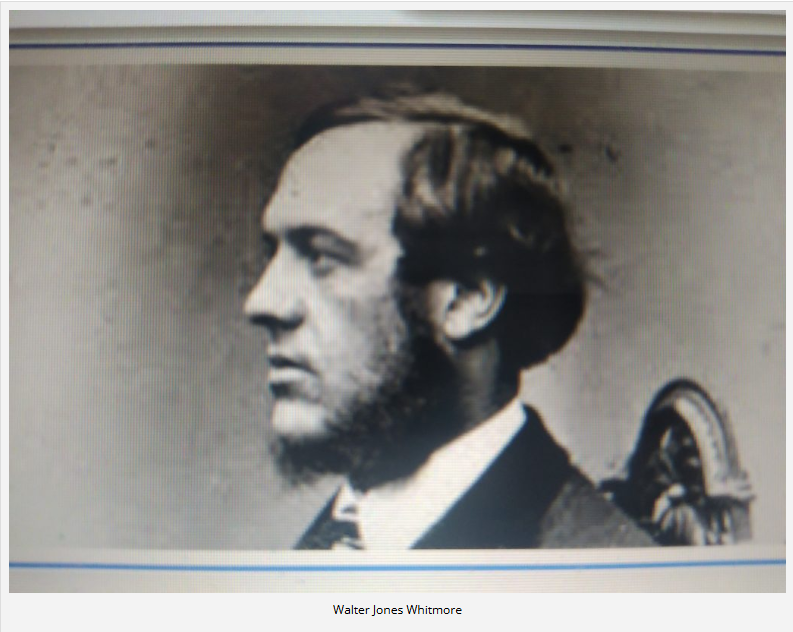
Walter Thomas Jones Whitmore was a founder of the All England Croquet Club and the first to develop croquet laws which would be consistently and widely used.
Jones Whitmore discovered Croquet in 1860 and this became a consuming passion.  He laid lawns at Chastleton House and realizing that there were no standard rules (croquet set makers produced their own), he set about creating both rules and tactics.  In conjunction with The Field magazine, he took the major role in compiling the rules and these were published in 1866, and were known as ‘The Field Rules’.  The croquet historian Arthur Lillie noted his success in ‘transforming the game from the silliest of open-air games to the most intellectual one’.  He continued to write articles on the game for The Field, which then formed the basis of his book ‘The Science of Croquet’ published in 1866.

Jones Whitmore organized the first croquet tournament at Evesham in 1867 which he won and from then on styled himself as the champion of croquet.  His zeal with regard to the laws of the game remained unabated and in 1868, the rules were revised by a committee of three, of which Jones Whitmore was the most influential member.  In that year, Jones Whitmore was instrumental in the founding of the All England Croquet Club (AECC), of which he became secretary.  The Club, however, did not have a ground and Jones Whitmore started to search for one. The search drew a blank and in 1869 he was dismissed as secretary in 1869 but refused to go down without a fight.  He created another All England Croquet Club, later called the National Croquet Club (NCC).  The original All England Croquet Club continued to develop and in 1869 found a ground at Worple Road in Wimbledon which remained the Club’s headquarters, and that of lawn tennis, until 1922 when the Club moved to Church Road, where the All England Lawn Tennis and Croquet Club (“Wimbledon”) is situated today.

Although the AECC and NCC were separate entities, they co-operated on revising the laws in 1870 with Jones Whitmore in the Chair.   In 1872 Jones Whitmore refused to become involved in further revision of the laws and confined himself to the role of elder statesman.

Born Walter Thomas Whitmore Jones on 13 March 1831 at Chastleton House, Oxfordshire, Jones Whitmore was educated at Bridgnorth Grammar School and in 1850  attended St John’s College, Oxford University.  He left two years later without taking his degree and joined the civil service. Jones Whitmore was critical of both the civil service in general and of his superiors in particular, remarking: ‘he is so supremely ignorant on the subject that I consider him as under me’.  He left the War Office to try his hand as an inventor of games and other inventions such as The Railway Carriage Signal (1864 Patent No 1969), and the Bootlace Winder ( 1864 Patent No 619).  He had a marked tendency to tell others what to do: he drew up treatises on reform of the Civil Service, how to fortify the country and even told his sister Louisa how to improve her complexion, when to wash her face and how to brush her hair.  He persuaded Longmans to publish two volumes of his poetry which, like his games and inventions, was not enthusiastically received.

In 1867 he changed his name from Whitmore Jones to Jones Whitmore, tired of his friend Willie Dickins regularly pointing out on their walks down Regent Street the name Dickins & Jones above a drapery.

In early 1872 he became unwell with what appeared to be a chest infection but was in fact cancer and he died on 27 July 1872.  Walter Jones Whitmore was unmarried.  Chastleton House is now owned by the National Trust and the croquet lawns are still in use.


Walter Peel

Hall of Fame
Walter Peel

Born: 1847
Died: 1897
Inducted: 2013

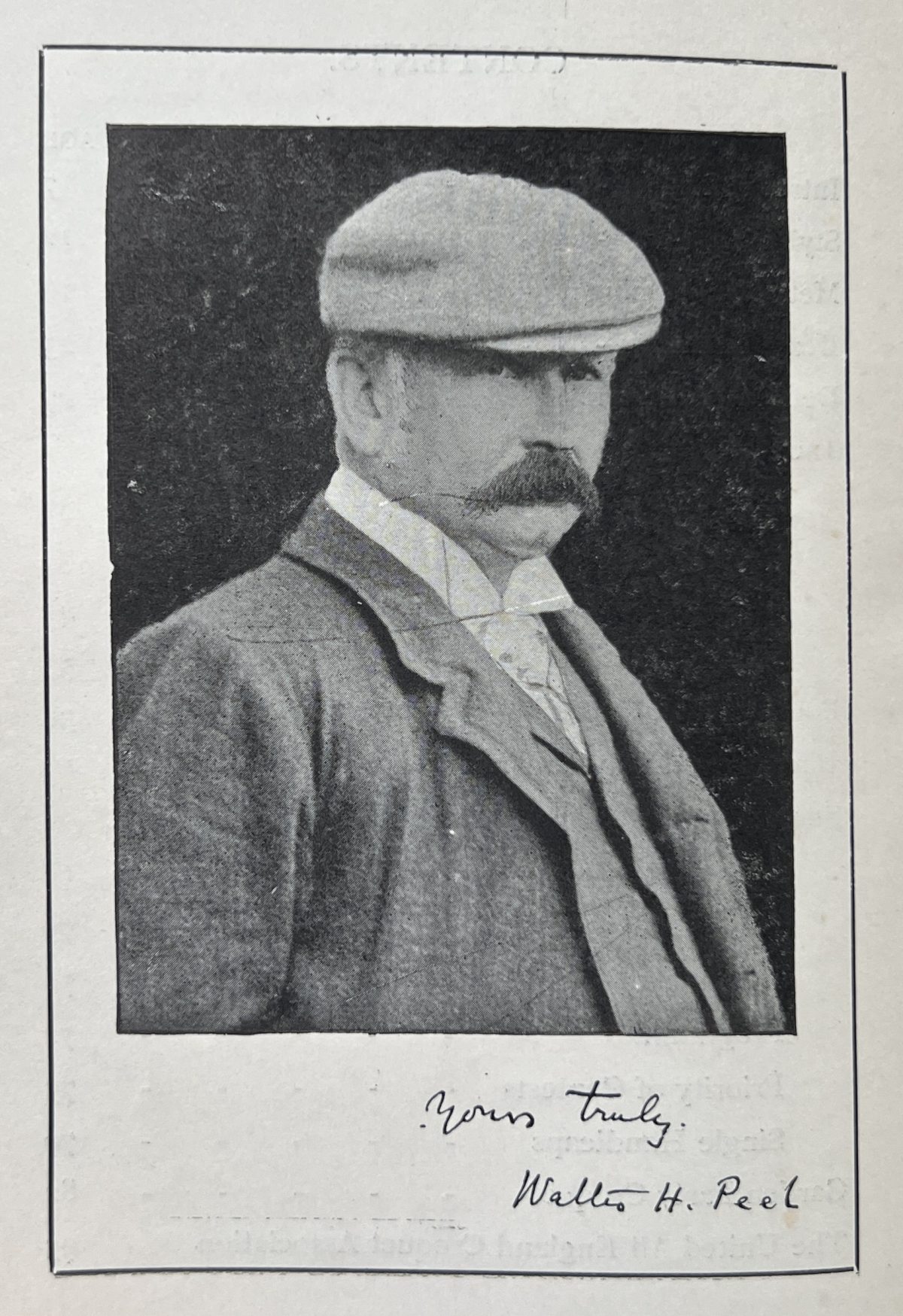
Walter Peel was involved in the early development of croquet as an organised sport in the late 1860s and early 1870s.  As a young man, he was a leading player and something of a prodigy, winning the Open Championship in 1868, 1870 and 1871.  Peel was partial to the practice of croqueting his partner ball through its next hoop and this became known as “peeling”, a term which is now a fundamental part of modern Croquet.
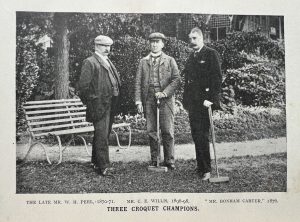
Croquet had been governed by the All England Croquet Club since 1871 following its merger with the National Croquet Club.  The AECC had occupied grounds in Wimbledon since 1869 and allowed the introduction of Lawn Tennis in the early 1870s.  The new game became popular and led to the AECC changing its name to the All England Croquet and Lawn Tennis Club in 1877.  Interest in croquet declined as the interest in and profitability of Lawn Tennis rose and croquet was finally expelled from the All-England Club in 1885.  This led to a very marked reduction in the level of tournament croquet in England until 1895 and, at this point in the game’s history, Peel made a second and ultimately much more significant contribution to croquet.

Peel had succeeded to his grandfather’s estate in Gloucestershire in the early 1870s and his appearances in tournaments then became rather spasmodic.  Nonetheless, he retained a nostalgic interest in the game and, encouraged by the success of a tournament held at Maidstone in 1894 and a modest revival of interest in croquet at Wimbledon, he decided to attempt to band together all croquet players in England in a single body to be called the United All England Croquet Association.  In June 1896, he circulated all the leading players of past and present with his idea and received an enthusiastic response.  In August 1896, a committee was elected and Peel became the first secretary of the new body which was renamed the Croquet Association in 1900 and has remained the governing body for English croquet ever since.

Photo taken from his book "How to Play Croquet"

Sadly, Peel died on 27 October 1897 when aged only fifty and so did not live to see the dramatic revival in croquet’s fortunes in the Edwardian era.  However, his brief second contribution to croquet was greatly appreciated and, following his death, he was honoured by the inauguration in 1898 of the Peel Memorials which are separate handicap tournaments for men and women.

Jack Osborn

Hall of Fame
Jack Osborn

Born: 1929
Died: 1997
Inducted: 2007

Jack was the founder and inaugural President of the United States Croquet Association.  Having founded the USCA in 1977, he stated that his ambition was to be able to go from city to city in every week of the year and play croquet.   He lived to see the USCA grow to have 3,500 individual members and over 80 sanctioned tournaments played annually around America.

When the USCA was founded, the croquet most Americans were familiar with was the nine-wicket, short mallet, two-stake game which had been popularised in the 19th century and played in millions of backyards since.  Jack’s first mission was to convince the American public of the merits of the USCA six wicket game played on a closely-mown court with the same substantial cast iron hoops and heavy balls and mallets used in tournament croquet in other croquet-playing countries.  Initially, he was convinced that this was the only game to promote in America but later he came to recognise the merits of the more aggressive and dynamic “International Rules” game, as Association Croquet is usually called in the USA, and was delighted to see the USA admitted to the historic MacRobertson Shield competition in 1993 where it meets teams from Australia, England and New Zealand every four years.

Jack was an excellent and tireless ambassador and for the sport of Croquet, both in the United States and overseas.  As USCA President, he implemented the advice of John Solomon, the doyen of English croquet, that the first essential step for a new national croquet association was to agree a single set of rules.  He also co-wrote two books on the game, including From Backyard to Greensward.

In a speech not long before his death, Mr. Osborn said:

"The game of croquet, to which I have given such a large portion of my life, fuses so many different elements: competition, a fine eye, a sharp mind, a firm stroke, a large amount of patience, ability to plan ahead and, by no means the least, a control of one's temper.  Few of us have had all these qualities in hand in every game.  But they are there to strive for in all games.  Yet beyond all of these, our game provides that finest of outcomes: comradeship.  It is that which brings us together.  And it is that which I have always enjoyed, wicket by wicket."


Brice Jones


Hall of Fame
Brice Jones

Born: 1940
Inducted: 2013

Brice Cutrer Jones served in the United States Air Force in the Vietnam War in the 1960s.  After leaving military service, he went to Harvard Business School and emerged with an ambition to become an entrepreneur in the wine business.  He founded the Sonoma Cutrer Winery near Santa Rose, California in 1973 and built it up into one of California’s best-known Chardonnay producers.

The winery was a state-of-the-art construction and included two manicured grass areas suitable for four tennis courts.  Jones was already thinking about hosting charity events at the winery based on the opportunity for patrons to watch a sporting event which featured top players.

In the mid-1980s, he met John McCullough, an English croquet player, who was travelling through California.  Having listened to John, Brice decided to turn his grass areas into two first-class full-size croquet courts.  In August 1986, the first international croquet singles event in the history of Association Croquet took place at Sonoma-Cutrer and represented a landmark in the development of the sport.  The highlight of the week was Saturday which used the final as the backdrop for a lunch and charity auction.  The auction was extraordinarily successful and, by the late 1990s, was regularly raising $1 million for the Make-A-Wish children's charity.

Players were offered lavish hospitality, accommodation and transport from all over the world in return for a modest entry fee and Sonoma-Cutrer almost immediately became a must-do event for all top croquet players.  The opportunity to meet fellow players from all over the world was enormously attractive and the new tournament played a significant role in boosting Association Croquet as a genuinely international sport and in developing the growth of Association Croquet in the United States.

There can be no doubt that Brice’s early and continued efforts for many years on behalf of Association Croquet encouraged the emergence of a cadre of international quality United States players who could begin to challenge England, Australia and New Zealand.  The annual Sonoma-Cutrer championship represented international singles competition at the highest level and was the only chance for many US players to gain this type of experience.  It was undoubtedly a powerful factor which supported the admission of the United States to the MacRobertson Shield competition in 1993.

Brice remained firm in his commitment to the event and Association Croquet even after he sold a majority stake in the winery in 1999 to a major drinks company.  The Sonoma-Cutrer event continued until 2004 when the new owners decided to discontinue it.

Andrew Hope

Hall of Fame
Andrew Hope

Born: 1946
Inducted: 2006

The birth of a World Croquet Federation had been mooted several times but, in 1985, it was Andrew Hope who, as Chairman of the Croquet Association Council, decided that the time was right for a thorough exploration of the possibilities.

He took the initiative in contacting the Australian and New Zealand Croquet Councils and suggested that a meeting between representatives should take place at the end of the 1986 MacRobertson Shield Tour which would be held in England.

The meeting took place on 17 July 1986 and Andrew took the chair.  Representatives from Scotland, Ireland, Japan, South Africa, Switzerland and the United States also attended by invitation.

Andrew had prepared a draft constitution assisted by Stephen Mulliner.  This was discussed in detail and a number of issues raised, including the stated objectives, eligibility for joining the WCF, voting rights, officers and committees, subscription and frequency of meetings.

It was agreed that a steering committee should be formed with the responsibility of producing further drafts of the constitution and preparing the way for the formal establishment of the WCF.

The WCF came into formal existence at its inaugural general meeting at the Hurlingham Club in London on 15 July 1989.  It owes much to vision and foresight of Andrew Hope, whose steadfastness and patience overcame all the difficulties that were encountered.

Andrew continued his work for the WCF by acting as its Treasurer from 2001 to 2010.

Tom Armstrong

Hall of Fame
Tom Armstrong

Inducted: 2006

Tom Armstrong has worked tirelessly since 1965 to promote croquet in Australia, particularly in South Australia.

After viewing the success of the England MacRobertson Shield side in Australia in 1969, Tom decided to introduce croquet to students at several Adelaide secondary schools.  A regular weekly inter-school competition began involving up to 100 teenagers.  From this competition, ten new players joined croquet clubs with several continuing on to win various tournaments.

Tom was responsible for players such as Neil Spooner, Barrie Chambers, Mark Prater, Bill Smith and many other state and national representatives joining the ranks of croquet players.

For many years Tom and his wife Jean would travel to Queensland in the winter months to coach and assist with the recruiting of players for Maryborough and Bundaberg.

Tom has given his time freely to anyone who took the slightest interest in the sport of croquet. The folklore at Brighton in Adelaide's southern suburbs says that nobody who stopped to peer over the fence at the local club ever escaped the smooth-talking Tom Armstrong.  As far as the number of players introduced to croquet by Tom, the number is well into the thousands.  Many were short term players, but many more were to become long-term members at various clubs.